
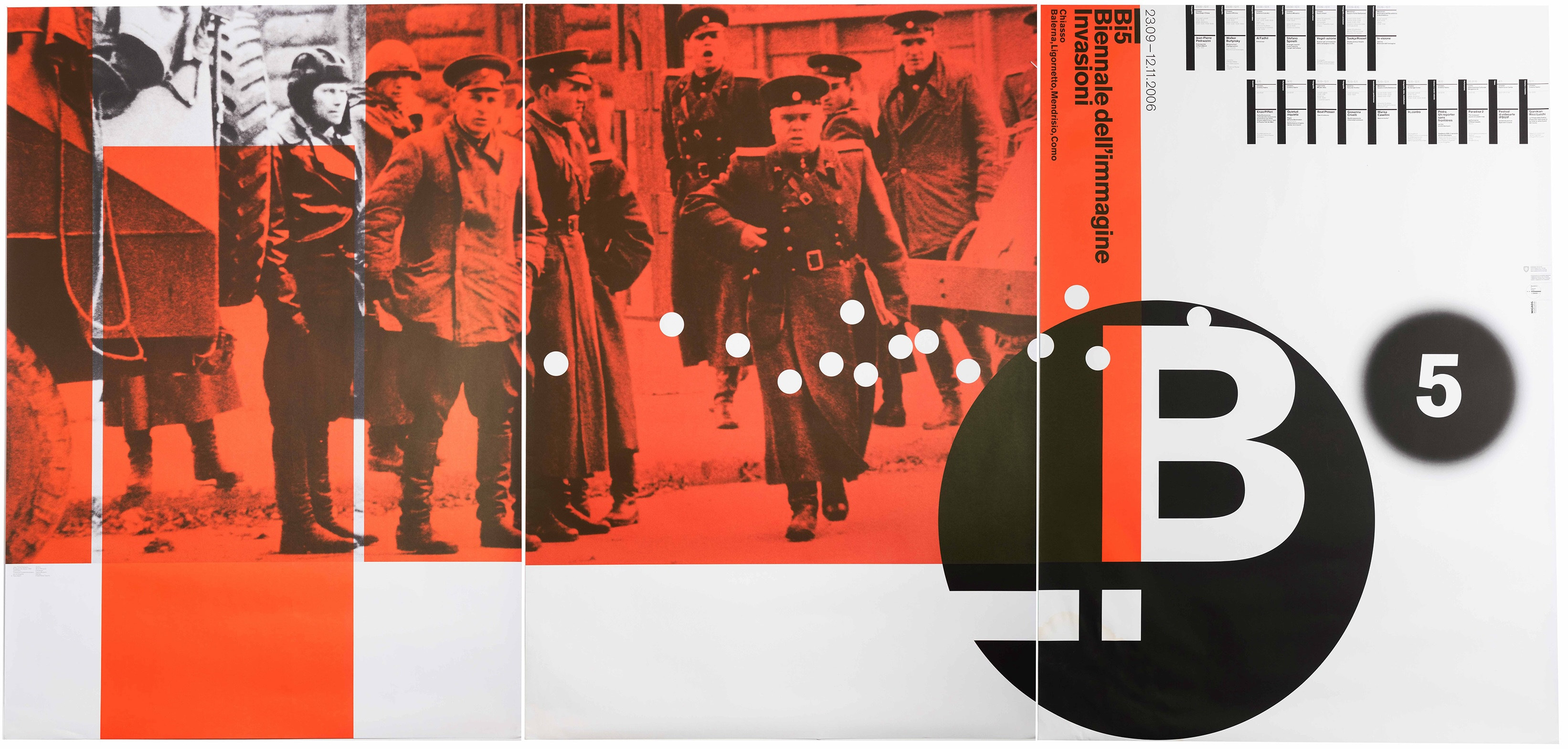
Bruno Monguzzi, Bi5, Biennale dell'immagine Invasioni, 3 posters in triptych, 128 x 90 cm each, 2006.
Bruno Monguzzi a not-so-Swiss designer: Rudolph De Harak
The International Typographic Style (also known as Swiss Design) came to life as a powerful and influential movement in Germany and Switzerland shortly after the Second World War. The designers involved in this design philosophy worked within a common syntax. They sought a pure graphic communication through an objective and impersonal presentation of information, devoid of subjective feelings and propagandistic techniques of persuasion. Their almost exclusive use of the typefaces Akzidenz Grotesk and Helvetica consisted of strong asymmetric compositions and powerful black-and-white presentations of images. Because their graphic vocabulary was so similar, it could at times be difficult to identify the author of a particular piece of work, even for those quite familiar with the work of the best designers.
Leaders in the Swiss movement, such as Max Bill, Armin Hofmann, Josef Muller-Brockmann, Carlo Vivarelli, Siegfried Odermatt, Rosmarie Tissi, Richard Lohse, Hans Neuburg, Carl B. Graf, and Karl Gerstner, to a name a few of the best, established a pure design criteria that became the standard by which almost all graphic design was measured for the next twenty years.
Their influence was felt as far away as the United States and Japan. This dynamic design philosophy didn't develop from just thin air. It found its beginnings in the manifestos of de Stijl, the Bauhaus, and Jan Tschichold, who perhaps did more to liberate type from its entrenched conservatism than any typographer/ designer of that time. Tschichold’s writings on design, Die Neue Typographie (Berlin 1928) and Typographische Gestaltung (Basel 1935), had tremendous impact on the Swiss and German design and typographic communities. The 1935 book was later published in English as Asymmetric Typography. Tschichold wrote:
“Sans serif is more expressive than any other face because of its wide range of weights (light, medium, bold, extra bold, italics).”
"...so, in the beginning of the twentieth century, a remedy was seen in using, in a particular job, different sizes of one and the same type face only. This was called Einheit der Schrift (unity of type).”
Strangely, in 1946, Tschichold, having emigrated to England, reversed his extreme philosophic position on the use of asymmetric typography and gave his full support to a revitalization of the use of classical typefaces and layout.
Bruno Monguzzi’s work, while clearly showing the influences of the International Typographic Style, has a spirit that transcends the objectivity and impersonal thrust common to that movement. It never quite fits the same mold. That is, Bruno seems to respond to the rules, but somehow his emotional and human side enters into the design process, with the result that his work expresses a warmth uncommon to so much of the work by other designers of the Swiss School and becomes highly personal. Yet the interesting point here is that his work appears devoid of a specific style. It is difficult to identify a Monguzzi design, because his design solutions have no preconceived matrix.
Theoretically, each piece could have been done by a different designer. Perhaps the best way to identify a Monguzzi piece is by the brilliance of the conceptual idea and the consummate skill and technique applied to its realization. Time after time, he brings this extraordinary skill to his visual problem solving. Few designers can achieve this level so consistently.
It is in this context that the manifestations of his design philosophies are in closer accord and can best be compared to the early (1930s) work of the Swiss designer Ernst Keller, whose designs strongly expressed content rather than emphasizing a consistent style or system. Additionally, the work of Herbert Matter, also a Swiss designer and photographer who later migrated to the United States, was of equal importance to Monguzzi, but from a different perspective. Matter's graphic design, augmented by his photography, was in many ways ahead of its time.
His strong photography and dynamic photomontages had the capacity to turn one’s orientation of space topsy-turvy. Matter could almost literally put the viewer on a roller coaster, simultaneously experiencing space and perspective from conflicting points of view. While influenced by artists such as Herbert Matter, Ernst Keller, El Lissitzky, and others, the manifestations of Bruno Monguzzi’s graphic design are entirely different. Creatively, he is without question his own person.
Could it simply be that his having been born in Ticino, the Italian section of the Alps, accounts for that strong, emotional part of him and that much of his need to communicate on a human scale, and being Swiss helps to explain that great care and exactness in his work?
Bruno came into this world at an extraordinary period of our history, just at the time that all of Europe was in war and chaos. Later, in the mid 1950s, just prior to entering into his teens, he began developing meaningful insights into the world about him. He had ideas about becoming an architect, but at the age of sixteen began instead his studies of graphic design at the Ecole des Arts Décoratifs in Geneva. Here he became acutely aware of the potentialities of design and those practicing it.
He was greatly impressed with and influenced by the designers mentioned earlier and by the pioneers of modem movements of the previous generation. However, I would speculate that Bruno's most deeply felt and lasting reactions were to El Lissitzky. The Russian constructivist's 1923 Self Portrait, his 1929 Russische Ausstellung poster, the photographic technique employed by his Pelikan advertisement of 1924, and his Prouns, among others, must have made an indelible imprint upon his impressionable soul.
The international spirit of Monguzzi’s work in his formative years owes much to his studies in London, his work in Milan for Antonio Boggen, and while there, exposure to some of Italy’s most influential graphic designers, including Franco Grignani, Max Huber, Giovanni Pinton, and Albe Steiner. This was followed by important work at Montreal's World’s Fair, Expo '67, and in the United States. The common thread tying Bruno Monguzzi's work together is evident in the deep thought and care that goes into every aspect of a design. His work shows a predominant concern for the development of a unique theme or conceptual approach that is sensitively integrated into the design. Every element of the design is given careful consideration, including scale, figure ground, type choice and size, cropping of photographs, and color relationships. Perhaps most important is his uncanny ability to anticipate how much to leave out so that the viewer can subliminally fill in the blanks and psychologically feel a sense of participation with the designer.
In a discussion of his work philosophies, Bruno stated that his interest in the Swiss approach to design ultimately suffered because“... it was so rigid in syntax that it was, in some cases, no longer functional.” Nevertheless, within this rejection there is, in my opinion, always an underlying structure that could only be the consequence of his early exposure to Swiss design. In the 1970s, with the establishment of the Post-Modern style, there was a distinct movement away from the International Style. Curiously, this was precipitated by the Swiss. As a consequence, some very different and interesting work developed. Many of the major designers didn't become involved in the Post-Modern style in any conspicuous way but continued to work in a manner that was most comfortable to them. Certainly, no apparent change is evident in the work of Monguzzi. Coming in contact with his work only reinforces the understanding that style per se is not the primary issue.
Bruno Monguzzi has made a very important contribution to the field of visual communication. His work is admired and influential not only in his own country and in Europe, but certainly in the United States and Japan. With the frequent superficiality and hit-or-miss quality of so much graphic design we experience today, we need more graphic designers like him, who bring an honesty, integrity, and unique quality of timeless creativity to their work.
Rudolph de Harak, Elsworth, Maine, May, 1998