
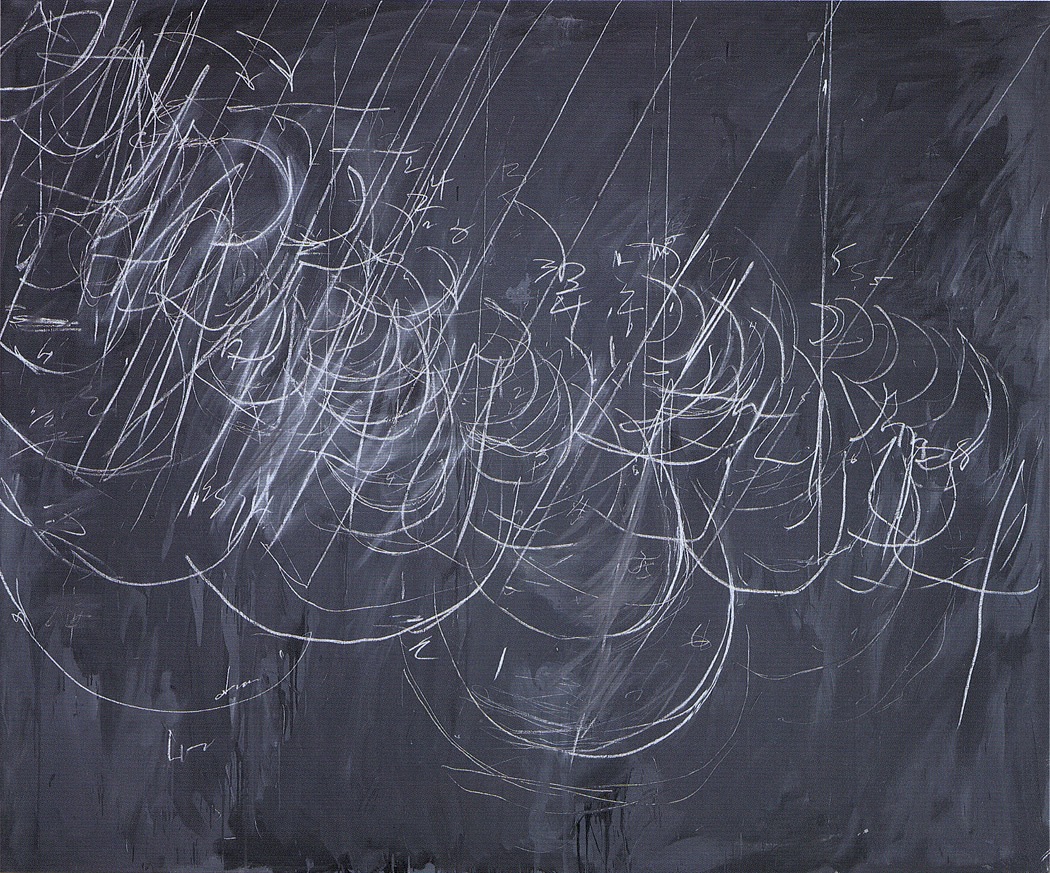
Cy Twombly. Untitled, 1968/1971 / Distemper and chalk on canvas, (200 x 239 cm).
The Alchemy of Mind and Hand: Suzanne Delehanty
"It is man," said Delacroix, "whom Poussin studied via the antique." Fascination with classical antiquity is legendary: in admiration of the Greeks, the Romans made replicas of their sculpture; Leonardo expanded classical knowledge with a humanist's passion for inquiry and clarity; Poussin left France to study in Rome. Virgil modelled his gods and heroes after those of Homer; in the Mediterranean, the Romantics found inspiration for the poetic ideal; Nietzsche extracted the essences of Apollo and Dionysus to categorize the polarities of human emotions; Goethe wrote Voyage into Italy; with bravura, Picasso challenged Poussin and all the ancients. The history of art belongs to all artists. What each chooses from the past reveals his affinities, and his means of appropriation lay bare his identity.
Since childhood, Cy Twombly has been passionately interested in Greek and Roman history and mythology. In his imagination Twombly revisits the classical world with a sensual immediacy and through his art he reinvents the past as a means of self-discovery. Drawing is the alchemy of Twombly's mind and hand, memory and imagination, reason and passion. Drawing transforms his experience into a personal actuality of sign and system.
Twombly's system of signs and their linear portrayal found an auspicious beginning in the late forties and early fifties when he attended the Art Students League in New York. The intellectual climate of New York was filled with ideas which, broadly speaking, were existentialist: the moment, myth and the situation preoccupied both artist and intelligentsia. The surrealists' advocacy of the irrational had liberated the creative community and contributed to the emergence of abstract expressionism as the leading 'modern' style. When Twombly was barely twenty, Pollock was painting his heroic canvases.
In 1951 at the suggestion of his friend and contemporary Robert Rauschenberg, Twombly went to Black Mountain College in North Carolina where he met Ben Shahn and two major leaders of abstract expressionism, Robert Motherwell and Franz Kline. Motherwell's elegant calligraphy and his interest in the automatic handwriting of surrealist artists, as well as his thorough appreciation of symbolist poetry, cannot be discounted as early influences on Twombly's attitudes about art. Certainly, Twombly's black and white paintings such as Iala 1951 are indebted to Kline and Shahn. Although he was to reject the aggressive emotion of the abstract expressionists, as Robert Pincus-Witten has observed,1 Twombly did bring to his own art the expressionist's roots in surrealism with its affirmation of the creative moment.
Many of the thematic and formal elements of Twombly's mature style are implied in the early constructions, drawings and paintings. His imagery ranges from the illusive figure of Untitled 1952–1953, rising in archaic mystery like a cycladic votive statue, to landscapes with wing-swept movement hovering centrally on the canvas. The constructions made of found objects, wood, string and cloth, which Twombly described as "kind of homemade looking,"2 occupied him sporadically from 1952 to 1954. For Twombly as well as for Rauschenberg and Johns at this time, working three-dimensionally was a way of exploring materials. In the constructions, string and wire lines, soft extended pouches, and ordinary doorknobs become brooding, ambiguous forms with human attributes. In both the constructions and the paintings of this period, Twombly collaborated with his paint; he drew lines with his fingernails, incised the surface with pencil and palette knife. Frank O'Hara eloquently recorded Twombly's response to materials in a 1955 review: "A bird seems to have passed through the impasto with cream-colored screams and bitter claw-marks. His admirably esoteric information, every wash or line struggling for survival, particularizes the sentiment."3 Not only do these objects and paintings reveal Twombly's directness, but they also bear the beginnings of a complex system of personal signs which would appear in baroque abundance in his later work.
By the mid-fifties Twombly began to merge figural and landscape lines into random, but calculated, events sweeping canvas and paper. Pencil lines bearing fragments of rectangles, half-born numbers and letters move across the canvas in a manner reminiscent of Pollock's allover compositions. Unlike Pollock's and Kline's robust drawing, Twombly's line is nervous and swift like Giacometti's; its lively refinement speaks of Klee, its biomorphic vestiges of the surrealist handwriting of Miro and Gorky. The fresh immediacy of his line, which at a superficial glance might resemble street graffiti, is highly educated and deliberate. As Nicholas Calas has noted: "When the act of painting does not involve the formation of either image or geometric forms, the artist's oeuvre is most readily understood in terms of a development of a personal style of 'handwriting'. In antiquity the connection between painting and writing seemed obvious: in ancient Greece the word egraphen (i.e. written by) was affixed to the artist's signature."4 Twombly's remarkable draftsmanship with its rich tonal scale would become carrier of sign and system, autobiography and landscape, bearer of eros and logos.
The journey to Rome which was crucial to Poussin was no less so to Twombly. Rome, his home since 1957, put him in direct contact with layers of the antiquity that had fascinated him since childhood: the Forum seen from the Campidoglio, medieval streets along the Tiber, windowed facades of Renaissance palaces became part of his environment as they had for the Romantic poets in the nineteenth century. It was the magical convergence of specific place, maturity and perhaps a more sympathetic ambience than he found in the United States. Here Ovid, Leonardo, Raphael, Poussin and Keats released in Twombly a potent creativity which emerged in an art uniquely his own.
In Arcadia 1958 the tentative letter-like marks become legible inscriptions. This use of words and signs ties Twombly to a long genealogy from the Egyptians, whose hieroglyphs Plato called "gardens of letters,"5 to the cubists, to the dadaist Schwitters, to Magritte and Klee, the surrealist poet–painters. For Twombly, words written on the works such as "meditation," "bang," "memory," "song," hold thoughts which drawing could not. Under the influence of his new Mediterranean environment the tight compositions made in New York expand into the light-catching constellations of an Arcadia which question the difference between reading and seeing. Perceptual ambiguity is central to Twombly's system of either/or/and readings. Equivocal symbols and words complete his vocabulary of signs. Akin with dada and the surrealists, he delights in puns: Actaeon appropriately looks like action; cavo ("hollow" in Italian) becomes Cairo. In a series of 1966 works, "agori," a word scribbled on the wall of his son Alessandro's playroom, becomes the invented plural of agora. Arcadia is also Twombly's invocation of Poussin's et in Arcadia ego and reveals his self-identification with the neoclassical, romantic landscape tradition. Lines cling to the surface of Arcadia in the arrested time of Virgil's unattainable pastoral, where frustrated love and death are unreal, a blissful state which Twombly would continue to seek in his art.
In the following year, erotic male and female symbols along with suggestions of architecture—memory notes perhaps of the temples and sculpture depicted in first-century Roman wall painting—began to inhabit Twombly's pastoral landscapes. In View 1959, as in the drawings made during the summer by the sea in Sperlonga, winged phalluses, a notation to Alexander and provocative heart-shaped forms which can be read simultaneously as breast, vagina and backside multiply with lusty playfulness in sea-lets of creamy paint. Like an antiquarian's findings, Roman numerals also appear as markings and, more precisely, as dates for drawings and paintings made at this time. Arabic numbers count out intervals and figures on the canvas and paper: Are they cast as cryptic measurements? Are they symbols for states of mind? Notations for pictorial movement? Abstractions of personal relationships? Fragments of time? As the only immediately recognizable signs, these numerals whose multiple meaning is sensed but not known, bring the viewer into Twombly's drawn fiction. Although more elusive than Jasper Johns's emblematic numbers, both Twombly's and Johns's mathematical figures assure us of the picture's irrevocable flatness. Unlike suggestions of architecture and landscape, which in the mind's eye are associated with space in the tangible world, numbers no less than words are symbols without physical dimension.
Concurrent with these tableaux of carnal desire, Twombly did a suite of drawings called Poems to the Sea, which recall a similar series by Motherwell. Just as sexuality is an analogue for artistic creation, the timeless sea, a theme which would reoccur in grandeur in Twombly's later work, is here an emblem of elemental drive. In the work of the early sixties, erotic figurations drawn with uncanny marine rhythm sometimes merge with aquatic themes in a distillation of basic human forces or erotic themes are particularized by mythological and poetic references. Rectangles, appearing tentatively in earlier work, become pictures within pictures, moments of logical order amid erotic figurations. Sometimes they contain schematized mountains which read simultaneously as reflections of mental geography or oneiric charts. Frequently these rectangles, masquerading as ancient plinths, centralize the composition and carry inscriptions from Sappho, Keats and Mallarmé. Quotations record the word or word-sounds that inspired Twombly and document an association made in the drawing process or a flashing union with the poet's imagined moment of cognition. Poetry and literature charge his imagination and bring forth images. This process calls to mind Baudelaire's realization that "It is Imagination that first taught man the moral meaning of colour, of contour, of sound and of scent. In the beginning of the world it created analogy and metaphor."6
As in French symbolist poetry, Twombly's pictorial system is a-narrative. The relationships among his words, numbers, erotic pictographs and globs of luscious paint are alogical and non-sequential, an order which follows our impressions of felt experiences. Drawing is the convergence of mind, pencil and hand to distill out of the time of real events single moments of conscious recognition. In describing Twombly's drawing process Heiner Bastian called upon Pound: "This for an instant and the flame is gone."7 Twombly's concern with the moment as the only means of understanding his own existence echoes the existentialist and surrealist atmosphere of his New York years. For Twombly, drawing is both the principle of visual creation and autobiography. Like journals, the paintings and drawings almost always bear along with his signature the name of the place where they were created: Sperlonga, New York, Mykonos, Captiva Island, Bolsena. Twombly absorbs and reconstitutes the singularity of each new landscape which, like the polymorphous places of the ancient hero's voyage, releases the unknown self.
While many artists were finding inspiration in pop culture during the early sixties, Twombly—removed from New York by choice—transformed his arcadias into epic panoramas; his erotic, surrealist-rooted tableaux metamorphosed into mythical episodes of violent and tragic love. It was not newspaper headings and supermarket shelves—the usual repositories of modern life—that gave him visual stimulus, but rather the majestic panoramas, classical landscapes and love cycles from the High Renaissance and the Baroque, that satisfied both Twombly's temperament and his new need for pictorial scale. Although Twombly did not draw directly from these sources, Raphael's The School of Athens and also his frescoes of Galatea's triumph in the Villa Farnesina, a five-minute walk from Twombly's residence, and perhaps Galatea's descendants by the Carracci and Poussin were at the forefront of his visual memory.
Many of the large canvases from 1961–1962 are composed with panoramic space; rectangles, grids, abbreviated stairs and composite temples establish spatial zones comparable to those created by the antique ruins in classical vistas of the eternal Rome, or function as props in a stage setting for the re-creation of personal drama. In The Italians 1961 a pantheon of erotic signs—breasts, lips, phalluses, hearts, slashes, scribbles of oil base crayon—enact complex private epics. Drips of pink, red and blue paint in August Notes from Rome 1962, for example, course to the lower edge of these canvases like a Dionysian aftermath.
In contrast to the open panoramas, Twombly interpreted Raphael's noble interior space with arched bands of thickly applied paint in his own The School of Athens 1961. A proscenium space also characterizes Twombly's mythical episodes of perverse and unrequited love. In both Leda and the Swan and The Triumph of Galatea, a painting and a drawing from 1961, highly charged lines explode front and center. Twombly squeezed paint onto the Leda canvas directly from the tube in color figurations at once seductive and repulsive; color is smeared into motion with an intensity equal to mythical love-hate attractions. Twombly's heavy use of color in the tormented love cycles was sudden. Although mood rendering washes or lines of colored pencil and crayon had appeared previously, Twombly's art was and is grounded in his drawing and aristocratic underpainting.
In an interlude of overt self‑examination, a recurring aspect of Twombly's art, he analyzed the significance of color in a 1962 painting inscribed "Sappho: But their heart turned cold + they dropped their wings." Along a high horizon line in the Sappho picture, he put down a patch of white pigment with the annotation "cloud"; a black scribble, resembling a mound of Venus, is captioned "mirror." Daubs of color in an enigmatic heart‑palette shape below the horizon line are labeled "white for diluting dreams...brown for earth...red for flesh and blood."
During 1963 the examination of tormented, albeit mythical love relationships became an equally brutal analysis of color and personality. The bloody deaths of heroes and powerful men possess Twombly in a series of portraits of Apollo, Achilles, Patroclus, Actaeon and Pompey who, like ancient alter egos, join the artist on canvas. Twombly was attracted to the contradictory personalities of these men of myth and history; he found them perfect examples of action and sensibility.8 In these portraits, such as Untitled 1963, vestiges of rectangles lie within a vertical format, constructs for the near and far pictorial spaces found in Renaissance and Mannerist portrait painting. The intermediaries for Twombly's portraits, however, were the antique sculpture which he collects. He did not portray his gods and heroes in the moment of classical apotheosis like the busts that silence the Grand Salon of Statues in the Capitoline Museum. Rather, he whipped asunder the sculptural pedestal with red paint to unmask the heroes' human moment of death, a violent death which was their shared and tragic fate.
In the Discourses on Commodus 1963, an ambitious cycle of nine portraits conceived while reading Robbe‑Grillet, he not only explored the variations of psyche and color's psyche, but painting as an abstraction of time. Commodus, like many of Robbe‑Grillet's characters, is a classic anti-hero. Twombly found this emperor a hypersensitive person who, because of inherited circumstances, could not express himself artistically.9 Are the portraits masks like the guise of Hercules which Commodus adopted in his imperial statues? Are they windows on the self? Discourses on color? An expiation of expressionism? Portraits of the trials of painting?
It has been said of Paul Klee's art, "Everything we know of reality...comes to us through tormented paradox."10 This could be said of Twombly as well, for his art is rooted in the paradoxes inherent in perception and meaning. Twombly's Commodus is the idea of the artist's paradox: creativity suppressed to destruction. If Twombly's portraits of the hero's death can be read as the clashing of reason and passion, Virgil 1963 harnesses these polarities in an affirmation of poetic inspiration. In the Virgil picture, Twombly discarded the garish colors and brutal gesturing which personify Commodus for a pure white canvas composed with elegiac restraint, while his depiction of Commodus' tormented psyche becomes classical repose. With breathtaking self-assurance, Twombly recognized the exact moment of completion; in Virgil he knew a minimal number of markings could claim and hold pictorial space.
The paradoxes of love–the carnal and destructive love of Venus and Mars–finds its polarity in the mythical incarnation of the cosmic female. The Birth of Venus 1963, a subject that frequently appears juxtaposed to the Venus of profane love in the artist's notebooks and drawings since 1960, personifies universal creativity. Formed of ambiguous male and female shapes, Venus rises jubilantly through a high horizon line of ultramarine blue which, in both disposition and color, polarizes the orange pigment squeezed on the abundant figure. Through placement, quantity and gesture, Twombly–as miraculously as he carved out pictorial space in Virgil–transformed the vulgar orange paint into a seemingly dignified shade. Twombly's sea‑born goddess is a composite of the Venuses of art: the many‑breasted Venus of Ephesus, Praxiteles' legendary Aphrodite and, in its frontal, upward sweeping movement, of the nascent Venus of the Ludovisi Throne, a renowned fifth century B.C. relief in the Museo Nazionale in Rome. The Birth of Venus, like his 1959 Poems to the Sea, is an analogue for elemental movement and creative drive.
Just as the ancient Greeks created mythology as an explanation of natural phenomena and human character, Twombly used myths as a means of clarifying his own paradoxical and equally artificial system. Myth is at once an intermediary in the annexation of personal style and a betrayal of identity; Olympia is both the alienation of self and a vehicle of inspiration.
Twombly, by 1964, had emptied himself of epic panoramas and expressionistic portraits. Freed of the classical myth as the transport between his experience and his art, Twombly spent the mid-sixties sorting out the options and directions implied in his previous work. The window, words and numbers, the vertical portrait format and, particularly, the horizontal landscape would become agents for a more universal investigation of the nature of art. Movement, time and pictorial space would be conceived, not so much through the invocation of the myth as narrative, but through a rethinking of mythical characters as abstract principles. Self would be discovered, not through the mediation of Renaissance, Baroque and later art, but through a reconsideration of Leonardo, Duchamp and the Italian Futurists.
During the summer of 1964, spent at Val Gardena in the Italian Alps, Twombly did a series of drawings in which his persistent rectangle, more clearly centered, contemplates a passionate landscape of phalluses and hearts put into flight by scribble line‑patches recalling the mound of Venus which was captioned "mirror" in the Sappho painting. The mythical lovers' union and consequent fusion of identity recedes as the window of reason seems to brood over lost passion and intuition. The window of the Val Gardena series becomes in another 1964 drawing a carefully ruled rectangle containing the schematized mountain peaks familiar in Twombly's vocabulary. Beneath and on axis with the mountain peaks, which are drawn like seismographic charts of reason, lies a passionate tangle of hills bathed in orange‑pink. Landscape again is Twombly's vehicle for examining paradoxes of form and content; he pits disciplined renderings of peaks against curving, spontaneous line. These opposite qualities of form are juxtaposed states of being and correspond to the cosmic paradox of male and female.
The window questions the nature of art and the artist's activity in Untitled 1965, one of a sequence of witty drawings done in New York based on the theme of the artist and his model. A grid‑marked rectangle, a surrogate for the artist's canvas, now appears within the drawn window. Erotic palette shapes—alter egos—regard a voluptuous cloud‑like nude who, as object and idea, rests on a schematized pedestal. Captioned "modello," she mimics the classical odalisque. The conceptual exchange among palettes, modello and measured canvas shifts from perception to the ambiguity between illusion and artifice, reality and fiction. Twombly's parody of the artist and his model, a theme which has preoccupied artists, most notably Picasso, since Velázquez included himself in Las Meninas, is a vehicle for ponderous inquiry. What or who is the object and subject of art?
Twombly's playful mood in the palette and modello series becomes one of cool intellect in a group of works from 1966, appropriately called Problems. In these, as in Untitled 1967, Twombly abandoned his emotive use of color to reconsider the pictorial possibilities in the black and white color scheme he used early in the fifties. However, he now lightens black to grey, not to suggest a schoolroom blackboard, but to "make a black and white painting without making a black and white painting."11 Placed in the middle of the vertical canvas, the ubiquitous rectangle is an image of the painting itself. As opposed to the Renaissance notion of the canvas as reality's window, Twombly's rectangle is a twentieth‑century window, a construct to delineate near and far, interior and exterior pictorial space. It is, perhaps, an unconscious memory of Delaunay's window paintings. It is Magritte's eye!
The immobile rectangle is splayed and activated in a 1968 painting to create progressive movement into the imagined space of the canvas. Movement, space and time, central to Klee, are at the heart of Twombly's art as well. Around 1967–1968, Twombly isolated the abstraction of movement, whether at rest or in motion, and its coefficient, space‑time; the passionate centrifugal motion of Galatea is transformed into the supreme poetry of movement which intrigued Leonardo throughout his life. Leonardo, whom Twombly has always admired for his passion and cool intellect, became a guide for rational inquiry. It is as if Twombly entered Leonardo's mind to envision the affinities between natural and human processes—to see the drawn line, like a natural phenomenon, unfold in space and time. The movement of water, an equivalent for the creative process first used in Poems to the Sea 1959 and later in Birth of Venus 1963, inspired a large number of works with lasso lines springing across grey or cream‑colored surfaces.
In a group of collages Twombly acknowledged the kinship between these works, which have preoccupied him intermittently since 1967, and Leonardo's studies of geological motion. Taped at the top of one of these compositions from 1968, mirroring Twombly's association, is a facsimile of Leonardo's spiraling deluge study; below it, like distant echoes of da Vinci's storm, rolling lines scrawled on overlapping strips of paper move across the surface in a variety of tempos and moods.
Reminiscent of Leonardo's drawing as well as of Palmer handwriting drills and Klee's pedagogical exercises, these contracting and expanding lines incised into the grey surfaced canvas from 1967 merge drawing with painting. The inherent disparities of these two form‑rendering procedures, a dilemma for Twombly as it was, not only for Pollock and Kline, but also for de Kooning and Gorky, found resolution in the lasso line. The loop line, one of the early forms appearing in children's art, was a way for first Pollock and then Twombly to claim space in a manner at once elementary and sophisticated. For Twombly pictorial space comes to be through line rather than through the meeting of the colorist's painted edges. The drawn lasso line, which could suitably be transferred to painting, is Twombly's constant for endless transformation of pictorial space, movement and mood. At times the rolling line is tight and dense, as Twombly deliberately avoided drawing too facilely; at other times it bears windswept freedom and energy as in Untitled 1969 or it can expand, as it does in a 1971 painting, with sensuous fullness in an analogue for an exuberant Venus.
Even Alexander the Great is called into the investigation of motion in space and time. It is not the duality of the hero's personality but, like the exuberant Venus as the essence of earthly love, the hero as the embodiment of action that is Twombly's muse. The battle plan of Alexander's phalanx for Issus, which is suggested in the faint undersketching of a 1967 drawing on cardboard, is a conceptualization of movement in a 1968 painting, just as the calendar markings in Orion II from the same year are notations for time.
The confrontation of the problem of movement in space and time joined Twombly to the Italian Futurists and to Duchamp, creator of a personal system as enigmatic as his own. Like shadows of Duchamp's Nude Descending a Staircase, figure eights, frequent personnages in Twombly's cosmos of signs, borrowed perhaps from the mathematical symbol for infinity, multiply, recede and climb through the surface of a 1968 oil on paper to express, as does the 1912 nude, an abstraction of motion in space‑time. Parabolic curves intersect and weave in and out of diagonals in Twombly's 1971 reinvention of States of Mind, Boccioni's time‑space composition. Twombly's fiction for high speed is an expression of personal emotion as it was for the Futurists. It is also a study of light and shadow, a vehicle for disciplining the natural left to right direction of his drawing and an exercise in dynamic counterpoint.
Counterpoint also informs Twombly's overall working practices. For example, he shifted between proscenium and panoramic spaces during 1961–1962 or alternated the single image contained in a vertical format with the expanded space of a horizontal canvas. Together with the rolling line pictures which began in 1967, Twombly explored new possibilities for the rectangle; he multiplied the 'window' in several grey paintings to chart water currents as much as to establish an arena for formal action. An abstract notion again releases form from within him. In contrast to the shallow space‑continuum of the lasso paintings, muscular drawing not only throws rectangles and rhombs into perspective in Untitled 1968, but sends them diagonally into space to challenge the luscious trailings of paint which announce the picture's flatness and question the spatial fiction; the perennial paradox of the twentieth‑century painter.
The rectangle, a constant in Twombly's ever‑changing continuum, is merged again with the erotic pantheon of the early sixties in a group of works done in St. Martin and in Bolsena during 1969. Figure eights, phallic forms, scribble‑emblazed hearts, equivocal numbers and rectangles fly through these works to create a landscape that is both natural and psychic. Like a diary recording logos and eros, the atmosphere, rhythm and distribution of signs in the Bolsena paintings change from turbulence to weighted lethargy, from a preponderance of rhombic sheets to an abundance of phallic shapes. Color, the frequent agent of emotion, in Bolsena is subdued and autumnal; in St. Martin it is tropically lush. Emotive tones and suggestive forms in both works make visible the invisible currents which move through the time and space of a psychological landscape, a charting of the labyrinth of existence.
It is characteristic of Twombly's curious and erudite mind that he examines simultaneously the paradox in each situation and the facets of each phenomenon. If the complexity of Commodus’ character generated nine portraits of psychic color and time, movement led him to a more exacting study of time and space. For Twombly the act of drawing and painting holds Pound's instant. The process carries pasts and futures; it uncovers the present. Paradoxically, the tangible result of this activity is, in the visual arts but not in the performing arts, atemporal. This contradiction between the process and the finished work haunts Twombly as it does many artists of this century.
The romantic timelessness and expansive white spaces of Arcadia 1958 become the explicit time of measured spaces in The Veil of Orpheus 1968. Here horizontal line, which Twombly calls a time‑line, is reconstituted not only from Leonardo's drapery studies, Muybridge's photograph of a veiled bride, but also from Duchamp's bride and a tune from the twenties about Orpheus.12 The embodiment of the paradox of time, the mythical Orpheus, in an ancient relief sculpture, lost eternal time by lifting the veil of Eurydice in a fatal moment of human weakness. The convergence of many seemingly dissimilar elements into a personal, comprehensible whole discloses the machinations of Twombly's byzantine mind which creates the either/or/and readings underlying his visionary system.
Nine lines of varied weight and length quietly cross the four panels of the Orpheus picture at different points on the horizon; some are annotated with numbers set in multiplication or dimension form; in other instances, numbers bear the mark for feet or are followed by the word "miles" to signify the measurement of geographical distances. Numbers, wanderers from mathematics, a system as artificial as Twombly's own, give an aura of exactness only to elude definition. As seductive as the hearts in the erotic tableaux, the numbers draw the mind's eye into the vast expanse of the Orpheus canvas to participate in Twombly's speculations on measurable and infinite space and space's coefficient, time.
From the Veil of Orpheus 1968 came the time‑line landscapes and a group of collages called Treatise on the Veil. The elegiac restraint of Virgil 1963 becomes a patrician tranquility in the landscapes and paintings of the timeless sea which capture the essences of these natural phenomena as correspondents for states of being and qualities of form. The changing horizon of physically tangible places becomes a construct for pictorial space; two white lines, etched in suspension, float low on the horizon of Untitled 1969 or multiply in quiet grace across a paper painting from the same year. On these surfaces, veiled in grey paint, white line measures the time and distance between two points in space, as if the drawn line were the artist's analogue for points of planetary time and space.
The tranquility and detached intimacy of these grey time‑line paintings reoccurs in a series of buff and cream‑colored paintings made in 1971. With trembling stillness, ruled and hand‑drawn blue‑green lines calm the horizon in Untitled 1971 where elegant, transparent underpainting voices Twombly's counter‑brushwork down the picture's vertical surface; drops of paint acknowledge themselves, an acceptance of the painting's two‑dimensional reality both as fiction and as the artist's actuality.
Between the quiet grandeur of the time‑lines threading canvas and paper from 1969 to 1971, Twombly turned from the poetic to the rational implications held in the Veil of Orpheus. The Treatise on the Veil series from 1970 established, as did thematic motifs such as Twombly's water currents or Monet's haystacks or Picasso's bathers, a self‑defined sequence of works exploring related picture making problems. The collages from this series analyze tonal scale and layered surface planes. Twombly's use of numbers in the treatises signifies a methodical intent; no longer cast as enigmas, numerals now precisely codify the rectangular elements and define the organization of the spatial plane. Even the exchange of rubber‑stamped name and date for written signature manifests Twombly's detached objectivity.
Although tempered by poetry, the spirit of rational inquiry nevertheless continues in a number of collages which, in 1971, begin to appear with greater regularity in Twombly's work. Collage, which engaged Twombly briefly in 1959 and indirectly informed the shallow drawn planes found in other works, allies him to the dadaists and their descendants—Rauschenberg and Johns, among others. The invasion of visual information from everyday life into Twombly's work functions as commentary and, in many instances, elucidates the oblique references previously found in his art. Postcards and illustrations, which are often assigned the polar identities of 'male' and 'female'13 in Twombly's personal cosmos, are agents of both structure and meaning. Twombly reveals his process of visual association—the thing that set his mind and hand a‑going—in a 1971 collage in which he cuts into the drawing sheet to expose a reproduction of one of Leonardo's anatomical studies. This facsimile and the banal postcard of the Florida tree pods that appears in a collage made on Captiva Island in 1972 both establish an axial focus and function in the same way as the window or rectangle of Twombly's visual vocabulary. Gathered in Twombly's veil of crayon lines, pod‑like forms are transformed into provocative male presences, recalling the phallic shapes apparent in View 1959. Even the tourist‑stand postcard joins Twombly's own past to expand the possibilities and meanings in his ever‑renewing system.
A postcard; a trip to India. Incidental as well as major events are annexed and transformed by Twombly's mind and hand. Reading an ancient history book—literature his constant muse—sparked a drawing of the barge of Sesostris. A legendary journey to the sun or the phrase "love's infinite causes" enter Twombly's system. The lotus, symbol of the universe, becomes the dominant element in a 1974 sequence of collages composed of clusters of pencil and oil base crayon line as well as sheets and torn fragments of graph paper.
Botanical illustrations of mushrooms, in real life reminders of Alessandro Twombly's favorite pastime, are literally taken into Twombly's personal system as the foundation of a group of collages collectively called Natural History, Part I 1974, a project that calls to mind Pliny's lifelong undertaking Historia Naturalis. Like the creative process, the arcadian wanderings of the mushroom hunt demand intuitive and exacting knowledge, reason and passion. The mushroom is a compendium of polarities; both male and female, it is deadly and benign, repellent and attractive. Dense overlapping sheets of graph paper taped over and under arcs of automatic line are assembled with rectangles in the guise of mailing labels, four‑process color charts, grey scales and imageless snap‑shots. The compositional elements, as polar as the mushroom, not only establish positive and negative spaces around an invisible vertical axis, but play void against solid, dark against light. The radiating cap of the mushroom, illustrated in cross‑section, is measured by the echoing curve of Twombly's crayon line. Its shape and schematization is repeated in a consciously awkward architectural elevation which too is measured to scale. Both diagram and plan, fictions of plant and building, question the conceptualized measurements and two‑dimensional presentation. Convened without focus, this compendium of inseparable polarities of meaning and form evades an exact reading. Throughout his works these external elements and odd links to tradition, such as Leonardo, Duchamp, Poussin, mythology and poetry, are merely points of reference animating Twombly's inner vision and the mysterious private actuality of his art which expands to offer us a fresh window for self‑discovery.
Notes
1 Robert Pincus-Witten "Learning to Write" Cy Twombly Paintings and Drawings Milwaukee Art Center. Milwaukee 1967 unnumbered pages
2 Conversation with the atist, June 4. 1974
3 Frank O'Hara "Exhibition at Stable" Art News January 1955 p. 46
4 Nicolas Calas "Lettrism" Icons and Images of the Sixties by Nicolas Calas and Elena Calas E.P. Dutton & Co.. Inc. New York 1971 p. 131
5 Ibid. p. 132
6 Charles Baudelaire The Mirror of Art translated and edited by Jonathan Mayne Doubleday & Company. Inc., Garden City. New York 1956 p. 234
7 Ezra Pound "Histrion" Exultations Elkin Mathews. London 1909 p. 38
8 Conversation with the artist. June 4. 1974
9 "Conversation with the artist. June 4, 1974. It is also mentioned in Carlo Huber Cy Twombly Bilder 1953–1972 Kunsthalle. Berne, Switzerland 1973 unnumbered pages
10 "Giulio Carlo Argan Paul Klee: the thinking eye the notebooks of Paul Klee edited by Jurg Spiller translated by Ralph Manheim George Wittenborn. Inc., New York 1961 The Documents of Modern Art. Vol. 15 p. 12
11 Conversation with the artist. June 4. 1974
12 "Franz Meyer "Cy Twombly–Zeichnungen 1953–1973" Cy Twombly-Zeichnungen 1953–1973 Kunstmuseum. Basel, Switzerland 1973 p. 12
13 Sigrid Metken "Facteur Cherals Posttache, die Bildpostcarte in der Kunst" Das Kunstwerk January 1974 pp 7–6