
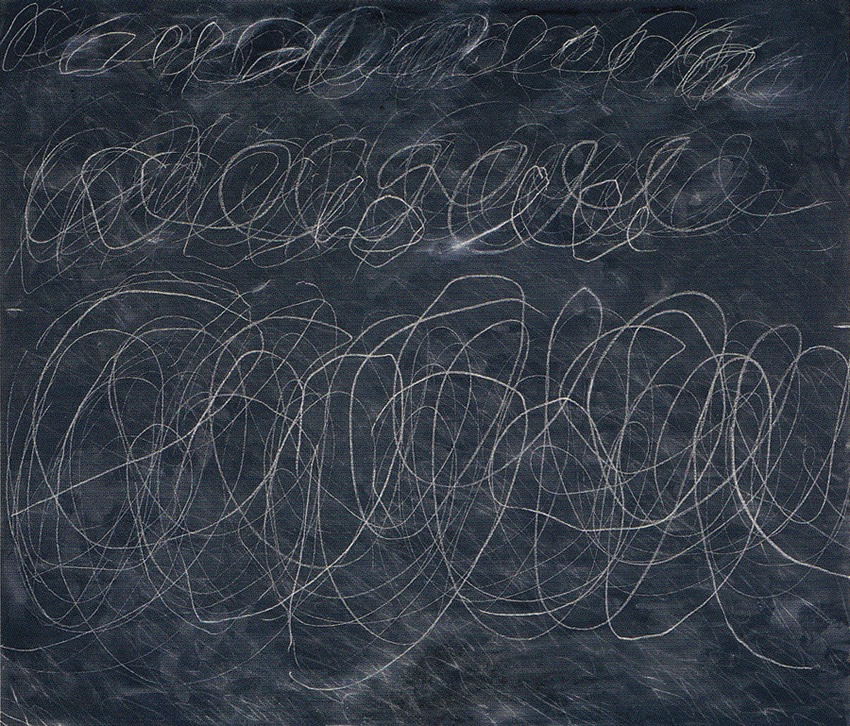
Cy Twombly. Untitled, 1970 / Oil-based house paint and crayon on canvas, (345.44 x 403.86 cm)
Your Kid Could Not Do This, and Other Reflections on Cy Twombly: Kirk Varnedoe
Genius is only childhood recovered willfully – Charles Baudelaire
"This is just scribbles—my kid could do it." That kind of remark, often directed at Cy Twombly's paintings and drawings, echoes one of the classic protests against modern art. It asserts that what is being touted as specially talented is in fact only something commonplace, which requires no skill and therefore merits no respect. It also implies a resentment that some self-appointed elite should try to foist onto others their pretentions about this "art," which the simple exercise of common sense can seemingly expose as readily as The Emperor's New Clothes.
The gap between such indignation and the often rapturous writings of Twombly's admirers may seem, too broad for any dialogue, beyond the dismissive slur of philistinism that attacked cognoscenti often throw back at their doubters. That derision gets us nowhere, though, and scants some basic truths that might at least provide a starting point for discussion. Its advocates know, after all, that Twombly's art does have something to do with scribbles and children's art—though in a more complex and indirect way than the mockers imagine, via the validating precedents of a lot of "classic" and widely loved modern art. And certainly if Twombly's work did not in some sense 'deserve" this kind of attack—if it did not pose a real challenge to accepted norms of beauty and craft, and have the capacity to provoke the uninitiated—it would not belong as it does to the modern tradition, nor hold the interest it does for its supporters.
It's also correct, here and elsewhere, that modern art does thrive on a kind of clubbiness that brings together in pocketed associations people who value one form or another of "difficult" or esoteric culturural activity. But it's the very self-appointed nature of those "elites; and their diversity, that recommends them; membership has always required enthusiasm, curiosity and commitment to debate more than exclusive credentials such as formal education or wealth. By devaluing what we know in order to change what we like (and vice versa) new art like Twombly's has in fact typically shunned established elites in order to form fresh constellations of adepts. These recurrent inversions have discomfited many who thought themselves believers in previous revolutions: and one of the most discomfiting kinds of change has been not the invention of something new, but the new valuation of something previously ignored or scorned.
Admiration for children's art is a prime case in point. Modern artists have repeatedly drawn on "outside" areas, from tribal masks to comic books, that were considered beyond the pale of high culture. But the specific attraction to the childlike also connects to a broader tide in Western cultural life, stemming from the romantic cult of childhood as a separate state of grace, more closely and uncorruptedly in touch with the wellsprings of nature. The parable of The Emperor's New Clothes itself, which affirms the superiority of the innocent eye, is a part of this outlook: only a child, as yet untrained to accept the sophisticated lies that blind adults, can see (and speak) the truth. Artists in this century have recurrently found that children's visual representations—with their economical simplifications, their disregard for accepted canons of proportion, and their untrammeled elements of fantasy—spoke with just such exemplary candor.
Ideas of what truth they told, however, have shifted repeatedly. Early in the century, modern artists thought children's stick-figures and other simplified renderings were "logical and "rational' ideograms that reflected the universal, innate language of the mind, not yet enslaved to the mere imitation of appearances that European adults had become trained to honor. Henri Matisse, Vasily Kandinsky, Paul Klee and many others studied children's renderings with great interest, and found encouragement for their various rejections of academic methods of depiction. Then the Surrealists (with clues from Sigmund Freud and others) linked childhood experience to the irrational energies of the adult libido; and they looked to graffiti especially as evidence that youthful marking and drawing vented primal aggressions. This latter taste drew a very particular connection between untutored art and the immemorial bases of society's discontents; in the Surrealist romance of untutored sign-making on public walls, liberation was linked to criminality, creativity to destruction, and beauty to the idea of the wound or defacement.
Twombly was heir to all of this, as to many other permissions accorded by the modern tradition. He thus began sure in the knowledge that art of great power and complexity could be built up from elemental marks and ragged, accidental effects—slashes of paint, even skeins of dripping—that were in themselves apparently artless and without order. He understood that the recurrent challenge was not simply to adopt different forms of such seeming disorder, but to weave from them new languages that were adequate to respond to the subtleties of a personal temperament, and sufficient to evoke an original set of metaphors about modern experience. This is what he set out to do with the "child-like" manners he developed, in several different ways, as his art evolved.
In the early 1950s, Twombly inherited a part of Surrealism's courtship of the unconscious through Jackson Pollock's free-form "writing" with paint; but he also absorbed some of the other, "vandal' aspect, filtered through Jean Dubuffet's emulation of scarred surfaces and brutally "naive" figuration. In the works Twombly made in the mid-1950s, such as Academy, some of the scale and abstract energies of New York School painting like Pollock's or Willem de Kooning's were forced together with some of the intentionally gritty, down-at-the-heels look of European art like Dubuffet's. Where Abstract Expressionism's gestural brushstrokes had been boldly decisive and fluid, these thinned-out layers of pencilwork were more scratchily nervous and episodic; and where New York School paintings had often been seen as the cathartic expulsions of existential angst, Twombly's seemed more to evoke a cumulative diary of frenetic worry. Scrambling his pencil through skimmed layers of paint. Twombly turned the heavy-muscled drama of his elders' style into a manner whose looser formal organization and peculiar combination of compulsiveness and hesitation seemed "child-like," not in any cute figurations or playful simplicity, but in thickets of markings that suggested the conflicted aimlessness of accreted defacements. Far from logic and simplified clarity, the juvenile element evoked was that of defilement and messiness; and the wedding of that energy to the high-strung nervousness of his spidery linearity gave Twombly's pictures their singular—and to many amateurs of New York School painting, singularly transgressive and unpalatable—personality.
In part. the willful scruffiness of a painting like Academy seems to reflect Twombly's personal affinity (first expressed in his attention to corroded artifacts of prehistory) for surfaces scarred by time; yet it also connects to the feel for a contemporary urban environment then being explored in the mixed-media combine works of Twombly's close friend Robert Rauschenberg. The "calligraphy" of Abstract Expressionism had seemed to speak of big-city dynamism sublimated within heroic individual gestures, but both Rauschenberg's collage imagery and Twombly's palimpsests of more prosaic "writing" conjured something less allusive and more concrete, grounded in a social vision partly redolent of their notably unheroic surroundings in an old loft district of lower Manhattan.
Only about five years later, however, in pictures like Empire of Flora of 1961, gestural expressionism came back into Twombly's work. Instead of scumbled and scratched walls, a bright, explosively aerated "landscape" space was evoked; and a fleshy array of hues, with evocations of carnal liquidity, replaced the drier ruminations of spindly pencilwork. If Academy has some of the shaggy, bohemian air of beat-generation urban jazz culture in the later 1950s, Empire of Flora has the more expansive and exuberant colorfulness that we associate with the Pop moment in American painting. The picture is, however, markedly European, not only in its title (evoking antique mythology) and in its evidence of Twombly's love for expressionist painters such as Chaim Soutine and Francis Bacon, but in its particular sensuality. Twombly had moved to Rome in 1957, and his exposure to what he has called the 'infantile" indulgence given to sensory life and instinct in Mediterranean culture was a powerfully liberating force in his adoption of new hues and a method of painting directly with his hands.
The fusion between attraction to this "infantile freshness and emotive freedom on the one hand, and a love of the ancient, deeply layered culture of the Mediterranean region (including Egypt and North Africa) on the other, is central to Twornbly's aesthetic. It has governed works as large and expressive as Empire of Flora, but also a series of makeshift sculptures that recall the tiny vessels and vehicles often found in ancient burials. Winter Passage LUXOR (1985), which has its parallels in the homemade toy boats that the artist collects as well as in miniaturized Egyptian tomb furniture, recalls Twombly's affinity for the whitewashed and sun-bleached surfaces of Mediterranean architecture. It also specifically echoes the felukas and Nile barges of Egypt, which served Pharaonic culture as a symbol for the voyage from life to the land of the dead. Evoking (as Freud did more pointedly) a congruence between universal childhood experience and the origin of mythologies, this rustic object looks back to Twombly's early admiration for the scap-assemblages of Kurt Schwitters and folds into itself a complex set of associations of youthful fantasy overlaid with the patina of age, and spontaneous play linked to immemorial meditations on mortality.
The qualities of childhood present in a huge Untitled work of 1970 are however, of a entirely different order. This thinly painted grey-and-white canvas and others like it have been called "black-boards" for obvious reasons. Their repetitive, run-on markings don't suggest playroom freedoms but schoolroom tasks (such as basic exercises in proto-penmanship). Much cooler emotionally than the works of the early sixties, these paintings seem as parallel to the aftermath of Minimalism as the 1961 paintings were to the advent of Pop; and we might well link them in spirit to a broad range of reductively concrete experimental music of the period. Most of the grey canvases were painted in New York (where Twombly had a studio in the late 1960s), and they were especially well-received by American critics, who saw them as acts of a kind of penitential self-discipline in which the artist renounced the "artier" splash of his earlier European color paintings in order to submit to analytic cerebration and systematic devotion to labor. Ironically, it was these reductive, colorlessly linear works that also eventually led Twombly most directly back toward the expansive ambitions of earlier Abstract Expressionism; the huge Untitled canvas, with its turbulent coils of all-over energy, was painted near the time Twombly saw a large room of Pollock's poured paintings in a 1970 exhibition, and testifies to his desire to reinvent in new terms the fields of epic lyricism Pollock's poured paintings had created.
Certainly the founding Director of lhe Museum of Modern Art, Alfred Barr, would have been deeply surprised to think that a future curator might mention Twombly and Pollock in the same breath; in the late 1950s, Barr responded incredulously to a visiting European's inquiry; "Twombly! But he's trying to kill painting." Yet as so often in modern art's past, what initially appears as nihilistic subversion can turn out to be an act of renewal and even admiration. Twombly in fact admires Pollock tremendously; and just as Cezanne sought to "re-do Poussin in after nature," so Twombly and countless other modern artists have held that the most powerful hommage to such an admired model is not to follow or mime the style, but to reinvent the art's perceived values in new terms. Opposed to the desiccation and distortion that academicism imposes in trying to emulate past achievements, such modern artists have sought to recover the founding spirit of past art through personal intuition, and recast it with unfamiliar forms and emphases that will make in more fully alive and newly challenging in the present.
Metamorphis is a key idea for Twombly—the effortless shifting of one thing into another and the dreamily fluid transgression of normal physical limits that he finds so frequently evoked in classical mythology. Translation is also a basic principle—the reimagination of poetry or art in other languages, such as Pope's recasting of Homer's Iliad in metered English verse (which in turn inspired a series of paintings on the Trojan war). In both these ideas, preserving spirit while drastically changing form is axiomatic; and Twombly's own manner can be seen in this light, as a means of recovering with a new edge some of the fundamentally challenging precepts of earlier modern art—especially those imperatives to authentic engagement with the act of making that required subverting accepted notions of finish, skill, and control, and encouraged an uncensored response to the promptings of personal energies. It is in this endeavor of unexpected translation, too, that Twombly so often reimagines the antique in terms of the juvenile. Listening not only to the lessons of his modern predecessors, but to an inner conviction that past art of all ages speaks to shared human concerns, he seeks to avoid mere nostalgia, and to obliterate any opposition between the life experience encapsulated in the high tradition and the visceral experience of the immediate present.
One could say that any child could make a drawing like Twombly only in the same sense that any fool with a hammer could fragment sculptures as Rodin did, or any house painter could spatter paint as well as Pollock. In none of these cases would it be true. In each case the art lies not so much in the finesse of the individual mark, but in the orchestration of a previously uncodified set of personal "rules' about where to act and where not, how far to go and when to stop, in such a way that the cumulative courtship of seeming chaos defines an original, hybrid kind of order, which in turn illuminates a complex sense of human experience not voiced or left marginal in previous art. While any isolated, individual mark or sign in Twombly's art—a scrawled phallus, a stumbling line of writing—might seem wholly common and without discipline, the poetry as it written out whole in paint or crayon or chalk or pastel, in each work as in the sweep of the career, is in fact inimitably personal in its inflections, and challengingly rich in the range of (distinctly adult) emotions it can hold in paradoxical coexistence. His singular fusion of raw and refined elements is such, in fact, that it has been criticized almost as often for "decadent" over-elegance as for childish crudeness. Both assessments direct us to something of significance, but only taken together do they begin to point toward some fuller accounting of the particular personality, and poetic pleasures, this art can hold. Twombly has refined the choreography of his "simple" elements—the ragged edge of contour, the shifting pace and tension of run-on line—into a signature style that presses continually on the surprisingly fine border that separates the most sophisticated and dandyish touch from the crude daub, and links truculent toughness on one side to trembling tenderness on the other. Grimy defilement and pristine restraint, blunt aggression and fragile vulnerability, epic rhetoric and confiding intimacy, liberated indulgence and strangling nervousness, casual vernacular and deft erudition, orgiastic fantasy and measuring analysis—these unlikely pairings flirt through Twombly's work in permanently unsettled ardor.
Cy Twombly: A Retrospective, on view through January to, 1995, was organized by Kirk Varnedoe, Chief Curator, Department of Painting and Sculpture. The exhibition is a survey of the complete range of Twombly's work and includes little-known works from the 1950s as well as key pieces, some never before seen in the United States.
Notes:
MoMA No. 18 (Autumn / Winter, 1994).