
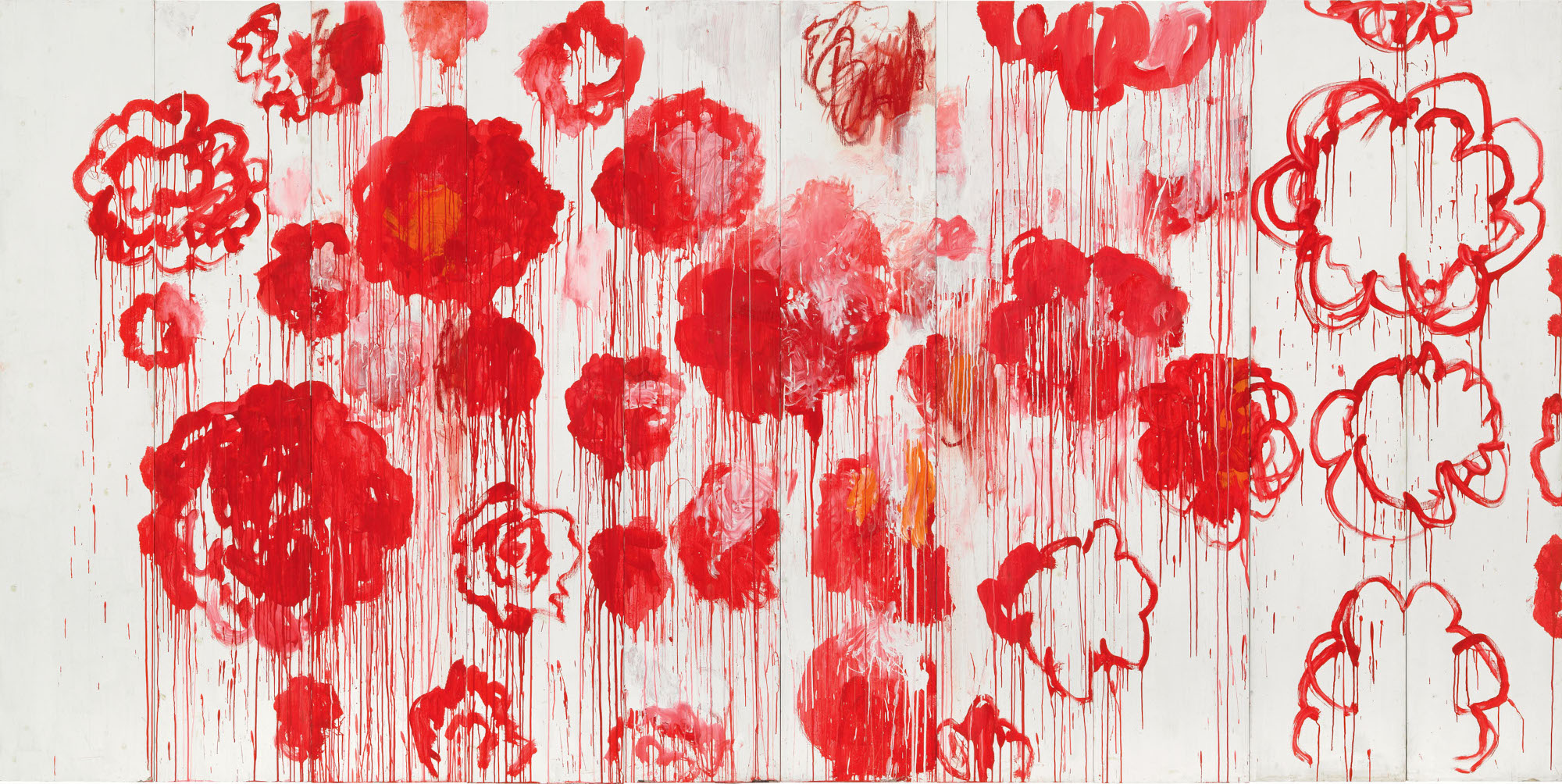
Cy Twombly. Blooming, 2001–2008 / Acrylic and wax crayon on panel, in ten parts, (250 x 500 cm)
Cy Twombly: An Appreciation: Harald Szeemann
Art historical writing continues to assess art by its mastery and/or freedom of expression, rather than by the degree to which this mastery or this freedom is sacrificed to achieve a new freedom – one that knows no fear of tradition because it is absorbed and transmuted, by its own presence in the here-and-now, into a new tradition which becomes a new present.
This takes place instantaneously, because when past and present interpenetrate they are not crystallizations of intentions and truths, but constitute a beginning and end in themselves. Such an espousal of freedom may spring from some deep cultural longing; or it may be the journey of the individual sensibility through successive layers of myth; or it may be a constantly renewed encounter between inner nature – always active, saturated with images and destinies – and outer, surrounding nature which, synchronously, becomes a sediment-like deposit in its inner counterpart. This freedom is also a journey through all that is, has been and is still to come, through desires, dreams and intimations, through restful pauses and through restless quests for the sources of imagination and the sprit. It is the collective memory moving amid all those shifting focuses of free association that make up the knowledge of eternal recurrence. These portions of imagination may circulate both slowly and quickly; they may be both prepared and spontaneous.
The individual who is the bearer of such gifts can be educated and childlike, tender and violent, wistful and passionate. His survival is ensured solely by preservation and communication of all the facets of the whole, in all their subtlety and in all those fragmentary traces which present them to others first as riddles and then, increasingly, as beauty. The result is both parable and pictorial ideas in one; it is a Glass Bead Game with the universe, a mental labyrinth of spiritual paths, lived out and rendered visible, which does not capture its motions and its pauses by using words, forms or formulae, but leaves them to come and go like the breath of meaning itself. This is the soliloquy of the great loner, the chosen individual, who feeds on the great cultural longing and uses it to create his works in the here-and-now of the painterly gesture.
No contemporary artist has so succeeded in dematerializing, transubstantiating, spiritualizing the content and expressiveness of line, colour and volume – whether found or imagined as Cy Twombly has. And this is precisely because the physical plays so great a part in his creative act. Lines of force, acts of force, eruptions of raw psychic energy, like those of the eruptive, Jackson Pollock phase of Abstract Expressionism, are all present in his work – but as a form of withdrawal therapy. They are the seismographic records of a sensibility so totally engaged that it instinctively incorporates a distancing device for its own protection. At first possessing the character of writing rather than script, these eruptions have latterly become waves of paint – controlled as to colour but expansive in movement – rather than self-referential splashes or masses.
Cy Twombly, born in Lexington, Virginia, in 1928, is a contemporary of Robert Rauschenberg and Jasper Johns. Like them, he is heir to the heroic days of America's first indigenous art movement, Abstract Expressionism, and to its fundamental contributions to pictorial creation: total freedom of content and composition; emphasis on the spontaneous gesture, straight from the artist's psyche, both as objective and subjective fact; opening up of pictorial space; and acceptance of the matter of paint as the essence of painting. All this brought with it, almost inevitably, the need for outsize formats. The painter standing in front of a large canvas felt like a pioneer in the desert; the energy of his inner visions was directly converted into the dynamics of pictorial genesis. For all these artists – whether concerned more with gesture, like Pollock and Kline, or with meditation on space and colour like Rothko and Newman - composition ceased to be a criterion of quality. What was important for all of them – whether they espoused the Active or the Contemplative Life - was the challenge that confronted the self in the presence of the primal, virtual space of the picture area. They made a tabula rasa of centuries of pictorial culture - and also of the elaborate expressive forms which the Surrealists devised to evoke the treasures of the unconscious, whether by giving shape to dream images or through 'psychic automatism'.
Cy Twombly grew up with this freedom. Line is an autonomous, vibrant, expressive entity; paint no longer stands in the service of representation, but is itself the matter and substance of formal creation. And yet even the artist's earliest drawings and paintings betray his individual approach. Twombly handles the new freedoms in his own way: neither combining elements, like Rauschenberg, nor meditatively complicating them, like Jasper Johns, he acts innocently and candidly, without techne, without guile. And so a canvas, a sheet of paper, or even an unremarkable everyday object, becomes, with all its inherent spatial, tactile, associative, suggestive qualities, part of a spatial continuum which the innocent artist unveils as the 'landscape of his actions'. The fruits of these actions embody the new freedom from traditional codes and thus constitute a new reality. Point, line and plane are pulverized, fragmented and given a new flux' The iconology of forms and the alphabet of communication are totally undermined. A signature no longer denotes the completion of a work but forms Part of the motion which the painting momentarily halts. Twombly's work is a dynamic notation, an epic script, which can only be grasped as a whole, not deciphered piecemeal. (Incidentally for a long time the drawn elements that intermittently crystallize out of the whole received a disproportionate amount of critical attention; there was much talk of childish scrawls and pissoir graffiti. As usual, these partial judgments have a grain of truth in them. Children and those in a state of arousal do automatically see things as a whole before they draw them; but what happens in Twombly's work is that the artist sets out deliberately to stimulate this way of seeing.')
For Twombly, the first thing is the line. It is something deliberately artificial and artistic. He has worked on his line, has made it supple enough to convey form, pace, depth and much else besides (Catlo Huber). The line, which Paul Klee called a path, a guide through the imaginary territory of the picture, becomes, in Twombly's hands, a vibrant, autonomous., complex 'self' and 'other' that roams through wider and wider landscapes, spaces and processes. Or, as Twombly himself says, each line is the present expedience of its own inherent history; it explains nothing, but is the event by which it is itself given concrete shape. This more complex, more natural interpretation of line gives rise to a subtler relationship to the picture area, and thus to its space and ground. Twombly distinguishes layers of colour by nuances, reinstating pictorial depth after its neglect by the pioneers of Abstract Expressionism.
Twombly is not alone in this. Parallels from the late 1950s exist in Rauschenberg's 'white' paintings and in those pictorial structures by Jasper Johns which are refined by contact with 'banal and sublime' objects. All have in common the emphasis on white. White as a non-colour, as a suspension of colour, is a symbol of the untouched, of the unknown, of the uncanny and of death; but it is also 'a silence that is not dead but full of possibilities. White sounds like a silence that can suddenly be understood. It is a nothing that is youthful – or more accurately, a nothing which still awaits its beginning, its birth. Perhaps the earth sounded thus in the white times of the lce Age (Kandinsky). Or, as Malevich put it: 'The movement of Suprematism is on the way to a white, objectless nature, to white excitements, to white consciousness and to white purity as the highest degree of every state, that of repose as well as that of motion .... This white nature will be an expansion of the frontiers of our excitement.' This is the sphere of Mallarme's 'ideal poem, the silent poem all in white'. Twombly seldom uses this evocative symbol, the colour white, in a pure state. As a painter he stands in the direct line of evolution from the Impressionists, for whom an admixture of white meant a light shining through matter, a lightening of the palette.
Twombly is masterly in the placing of his broken layers of white, in which he inscribes his signs and his eventful lines, and from which he simultaneously extracts them. Lines and forms are not set within a white context, as they are with the turn-of-the-century Symbolists, but embedded in the painting and thus bound in all the more intensely with the life of the pictorial space. This space affords them a location in which to deploy their ephemeral, inextinguishable presence. The insertions of white in Twombly's work are symphonic in their nature think of Whistler's Symphony in White – whereas his more conceptual paintings adopt a more neutral ground – a vibrant but impersonal gray. To this he commits his convoluted chalk or crayon lines, with their visible transitions, transposing the act of writing into a physical act. Twombly and this is the secret of his art – does not take possession of the picture surface; rather, he absorbs it into the place from which he operates – still and vehement, meditative and hyperactive, in a magma of emotions which refuse to be located in time or place and returns it to the outside world as the pictorial correlative of a moment caught on the wing. The objective and the nonobjective form and formlessness, naivety and subtlety, faint hint and drastic intervention: all these distinctions are superseded in this art of sublimated empirical experiment and disciplined, orgiastic expansion.
The move to Rome in 1957 did not mark a break: on the contrary the freedom of pictorial space, a heady acquired, drew new strength from the Mediterranean environment. The landscape, the light, the presence of Antiquity and the Baroque, the challenge of the Renaissance and Classicism, Leonardo, Raphael and Poussin, became part of a living dialogue, part of the present, in which the artist's own pictorial freedom became entwined with mythical and historical elements. The signs were now more explicit, the grounds more pervasive, more flooded with light. The visual continuum remained; the painterly elan became the instrument of narration and thus, in itself, en actualization of myth. Twombly's sensibility acquired a mythic dimension, bringing myth into the present in a way which exemplifies Levi-Strauss's dictum that 'myth remains myth just so long as it is seen as myth'. In their myths, the men of classical antiquity created a pantheon of incarnate, increasingly concrete, inherited images of gods, demigods and heroes, as well as mortal participants and victims, to represent all the situations of individual and collective life.
The mythical material of the birth of Venus from the foam, or of the amorous tussles between Leda and the Swan, Cupid and Psyche, Venus and Mars, is re-created in Twombly's painting through his own expressive resources and the naive, astonished, 'gauche' (Barthes) way in which he approaches the themes. Rome has intensified the process by which Twombly registers, rapidly and concentratedly, the material which forces its way from imagination into consciousness in the guise of memories of a dim mythic past. To conjure and invoke the gods, to link their action and their influence with his own creative process, to give them through his paintings the non-illustrative dimension of entering time and being experienced in all their concentrated power and powerlessness- all this led Twombly in 1961 to an intensification of expressive immediacy. Events and intimations alike now appeared flesh-red and blood-red; paint was smeared and kneaded, rubbed and rolled into balls, squeezed straight from the tube. Concentrations, rather than specific accents or acts of violence, materialized on the canvas; all was fleeting and suggestive, complex and direct, both more and less than symbolic.
Following on the liberation of line and matter, light – long active in Twombly's 'solsticizations' of line, his light-filled 'lunarizations' of the pictorial ground – has become his principal theme in recent years. The signs for sun, clouds and mirrors, for movement and speed, are transformed into a flux of colour, in whose waves the hapless, lovelorn Leander drowns. They have changed shape, like Proteus; they are metamorphoses in gesture, equivalents for feelings. Although this suggests a move towards the tradition of 'painterly' painting that runs from Turner and Monet to the present, Twombly, as always, evades classification. This is no latter-day 'sea-piece' or 'study of waves', but one great surge of paint, which swells from left to right in green, madder and white, sends aloft its clouds of spray and ebbs away at the right-hand side in tones of broken white. By contrast, Monet's late work at Giverny is governed by 'impressions' arising from daily contact with the constantly changing, magical environment that he had created in his garden: plants, paths, ponds, bridges and, occupying the centre of the stage, waterlilies. Monet's is a joyful, sensuous response to things seen. Closer to Twombly is the late Turner. This is the Turner who flooded the elements with light to the point of representing a disembodied drama of colour. In the tale of Hero and Leander, Twombly breathes into colour his personal vision of the impossibility of contact. In the depths there is peace for one who set out in the heat of the moment, like the wave, to meet his death in the sea.
All the beauty and elegance of the balancing act performed by this prince of painters is present in his sculpture of recent years. Who could forget the five sculptures seen just a year ago, five white objects that seemed to float above their pedestals? They are made from recognizable, used-looking, everyday objects cartons, crates, cardboard rolls, palm leaves, panpipes. The latest ones consist of sand mixed with plaster, or are directly worked in plasticine and plaster, before being cast in bronze or synthetic resin by a process that destroys the original. All these sculptures are painted with Cementito; the resulting nuances of white, and the intensity of light, rob them of their concrete quality as objects. They transmit an unreal, elusive radiance. They are transmitters of light, transmitters of silence, transmitters of poetry. Looked at closely, they reveal tiny shifts that create interpretative eddies and swirls. Three little pieces of wood, so placed that one is slightly raised, become a wordless, self-contained demonstration of tension, an optical, and no longer a tactile, event. This metamorphosis is immediately evident: with all the gaucherie of a naive artist, unspoilt and casual as ever, but including signs of the considerable time spent in meditation upon the objects and their past existence, Twombly bypasses alienation and transports them directly from banality to spirituality. Paint permeates the object, and drains it of all helplessness and absurdity, of its character as a piece of refuse. It enters the category of ennobled objects; it becomes sculpture. In the most recent sculptures the transitions from one component to another, or from horizontal to vertical, have been made smoother by pressing malleable material into the joints. The earlier sculptures include 'drawing'; the later ones flow and cascade like the waves of colour in the artist's latest paintings.
No other artist has such a gift for open-endedness. Numbers become dates, words become lines expressive of feeling, lines become tones, tones become tensions, white becomes resolution. All this happens with the flowing naturalness of handwriting, and of play, and in so individual a way that even related forms, such as those of Chinese calligraphy, seem alien. Twombly's script and signs embody a consciousness of time and, especially of light. Two-dimensional in themselves, they imply further dimensions of experiential space, enmeshed with the artist's own naturally elitist concept of time, which is relaxed enough to leave an expressive statement hanging in mid-air. The resulting wealth of images is nurtured by the whole imaginary museum of imagery and experience within which Twombly operates, not only seeking self-expression but, from a superior vantage-point, dominating the scene that he himself has set. This is so on paper, on canvas, and in the sculptural structures – all of them retain the freshness of speculative invention and yet hold within themselves the seeds of eternity. This work seems to us both primeval and innovative, like memory itself and its energies. Art at its best is a concentrated essence of life, imagination and dream – and of the audacities, the weaknesses, the fears and the desires of human beings and their gods. Art has its hard-fought battles and wars, its victories and defeats. Its creations are a synthesis of body, soul, heart and eros, a record of a momentary state within the evolving reality of an immense sensibility, which seeks to insert itself into the stillness of cultural longing: tender and vehement, conscious, spiritual, boundless.
Notes
"Cy Twombly: An Appreciation" translated from the German by David Britt – 1987.